If you need to sell an inherited house in Fresno, the first question isn't price. It's who has the legal right to sign the sale, and how long it takes to get that right. Once you know whether the house goes through a trust, a short court petition or full probate, the rest of the decisions get much easier.
I'm Christian Castro, a licensed California realtor (DRE #02195959) and the owner of Cash For Houses Fresno. A lot of the houses I buy or list across the Valley are inherited, and the families I meet usually have the same questions: Do we need probate? Who pays the property taxes now? Will we owe tax when we sell? Should we fix it up first? This guide walks through each one in order. It's general information, not legal or tax advice, so loop in a probate attorney and a CPA for your specific situation.
The short answer
- Find out how the house was titled. A living trust, joint tenancy or transfer-on-death deed can skip probate. Otherwise you'll likely go through the Fresno County Superior Court.
- Check the new $750,000 rule. For deaths on or after April 1, 2025, a primary residence worth $750,000 or less can pass through a short court petition instead of full probate.
- Know your tax picture. Your tax basis generally resets to the value on the date of death, and the property tax bill may reset too if no heir moves in.
- Then choose: keep it, rent it, list it, or sell it as-is for cash.
Step 1: Figure out who can legally sell the inherited house
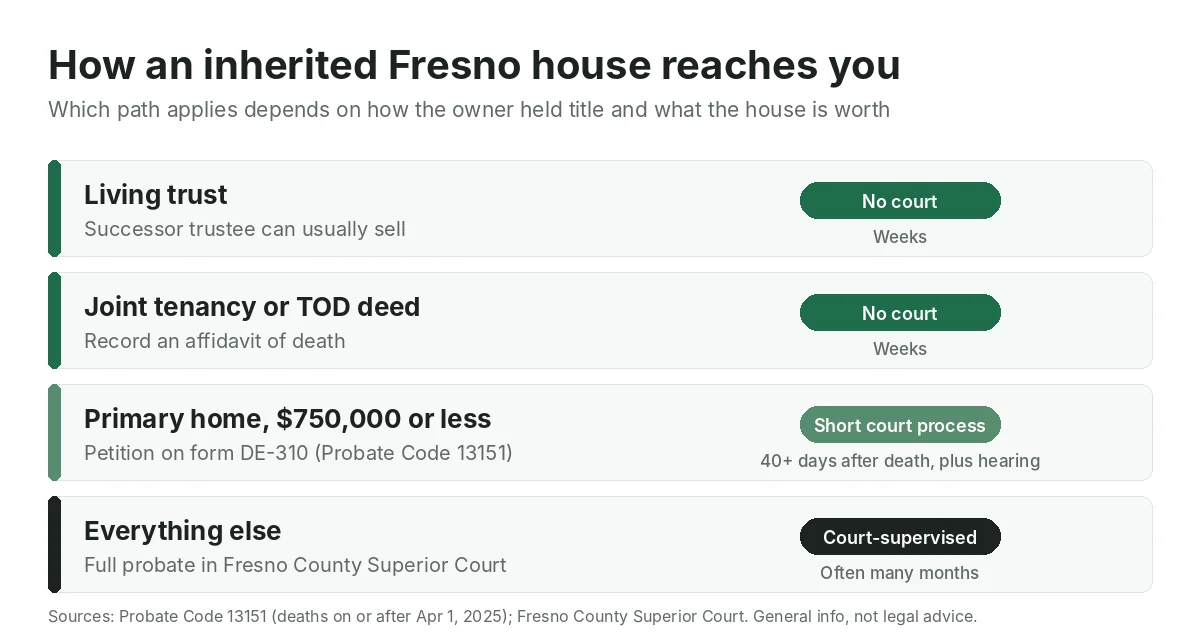
Nobody can sell a house until the county records show who owns it. When an owner dies, the house passes to the next person in one of four main ways, and each one has a different timeline.
The house was in a living trust
This is the easiest case. The successor trustee named in the trust usually has the power to sell without going to court. The title company will want a copy of the trust, the death certificate and a trustee affidavit, and then the sale works much like any other.
Joint tenancy or a transfer-on-death deed
If the house was held in joint tenancy, or the owner recorded a revocable transfer-on-death deed, the surviving owner or named beneficiary typically records an affidavit with the death certificate at the Fresno County Recorder. After that, the house is theirs to sell.
A primary residence worth $750,000 or less
Here's the change most families haven't heard about yet. Under California Probate Code section 13151, for deaths on or after April 1, 2025, an heir can ask the court to transfer the decedent's primary residence worth up to $750,000 using a single petition (Judicial Council form DE-310) instead of opening a full probate. According to a summary from Best Best & Krieger, the petition can be filed at least 40 days after the death, a probate referee sets the value, and heirs must be notified within five business days of filing. Before April 2025 the cap was only $184,500, so very few Fresno homes qualified. With Fresno County's median sale price around $418,600 in August 2026, per Redfin, most family homes here now do.
It only covers the person's main home, not a rental or a second house, and if there's a mortgage the heir has to work it out with the lender.
Everything else goes through probate
If the house was in the decedent's name alone, wasn't their primary residence or is worth more than $750,000, expect a probate case. Small estates have their own shortcut too: the general small estate limit for deaths after April 1, 2025 is $208,850, according to the Sacramento County Public Law Library, but almost no Fresno house fits under that.
Step 2: Probate in Fresno County, and what it costs
Fresno County probate cases are filed with the Probate Clerk at the B.F. Sisk Courthouse, 1130 O Street in downtown Fresno. The court's probate page lists the forms, clerk hours, probate examiners and the probate referees who appraise estate property. The basic path looks like this:
- File a petition to open probate and get an executor (named in a will) or administrator (no will) appointed.
- Receive letters of administration, notify creditors and heirs, and have the house appraised by the probate referee.
- Sell the house, either with or without court confirmation (more below).
- Pay debts and taxes, then ask the court to approve the final distribution to heirs.
Full authority vs. court confirmation
How the house gets sold depends on the authority the court grants. With full authority under the Independent Administration of Estates Act, the executor can sell after sending heirs a Notice of Proposed Action and waiting 15 days for objections. With limited authority, the sale has to be confirmed at a court hearing, where the offer must be at least 90% of the referee's appraised value and other buyers can show up and overbid. The minimum overbid is 10% of the first $10,000 of the accepted price plus 5% of the rest, as this explainer from Stimmel Law lays out. Court confirmation adds weeks and uncertainty, which is why many buyers with loans pass on probate homes.
The fees
California sets statutory fees for the executor and the estate's attorney as a percentage of the estate's gross value: 4% of the first $100,000, 3% of the next $100,000 and 2% of the next $800,000. "Gross" means the mortgage isn't subtracted first. Here's what that looks like on a house at Fresno County's median price:
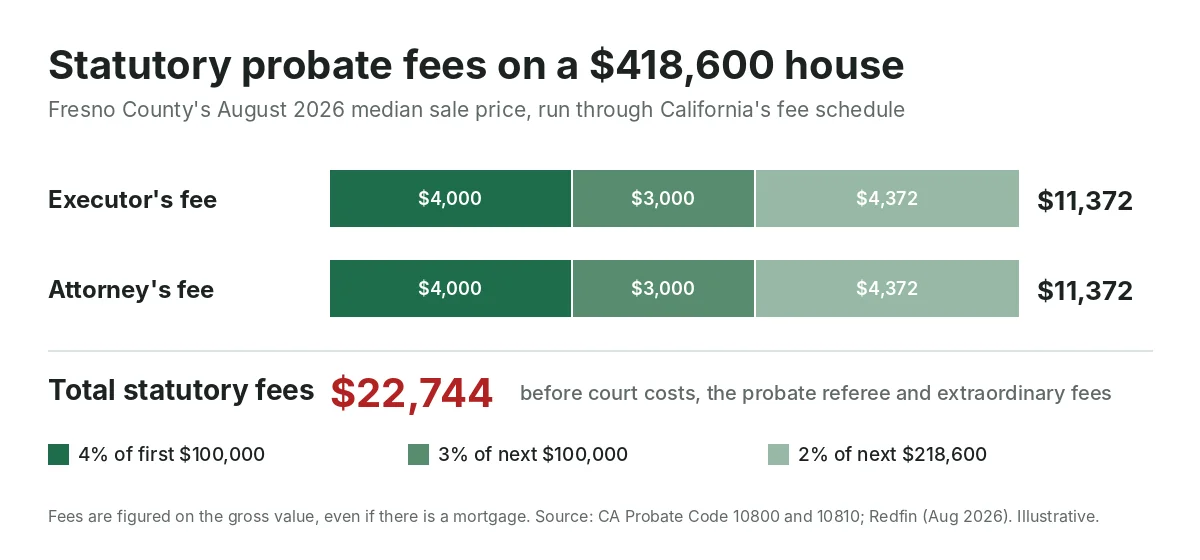
That's one reason the new $750,000 petition matters so much. For a qualifying home, it can cut both the time and a big chunk of the cost.
Step 3: Understand the taxes before you sell
Capital gains and the stepped-up basis
The good news: when you inherit a house, your tax basis is generally the fair market value on the date of death, not what your parents paid decades ago. The IRS explains that the basis of inherited property is generally its fair market value on the date of the decedent's death (or an alternate valuation date if the estate elects one). So if Mom bought the house in 1985 for $70,000 and it was worth $400,000 when she passed, a sale at $400,000 shows little or no taxable gain. Keep the probate referee's appraisal or get a date-of-death appraisal; your CPA will want it.
Property taxes and Prop 19
Before 2021, children could inherit a parent's low Prop 13 tax base on the family home almost automatically. Prop 19 changed that. Now the low base carries over only if the child makes the home their own principal residence and files for the homeowners' exemption within one year. Even then, the exclusion is capped: for transfers between February 16, 2025 and February 15, 2027, it covers the old taxable value plus $1,044,586, according to the California State Board of Equalization. If no child moves in, the house is reassessed at market value.
In plain terms: if you plan to rent the house out or let it sit, expect a higher tax bill. That's a big reason many heirs who live outside Fresno decide to sell.
Step 4: Protect the house while you wait
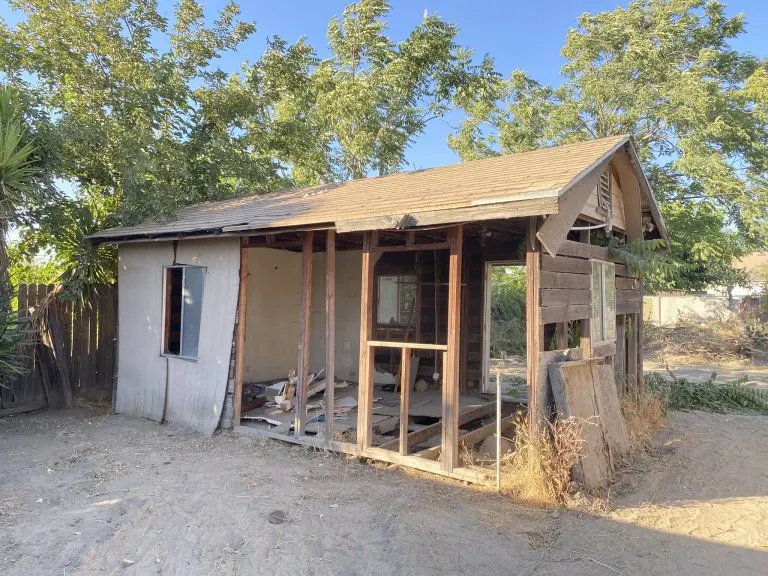
Probate or not, someone has to look after the property in the meantime. A vacant house in the Valley can go downhill fast, especially through a Fresno summer. Before you list or sell:
- Call the insurance company. Many homeowner policies limit coverage once a house sits vacant, so ask about a vacant-dwelling policy.
- Keep utilities on at a basic level so the yard, plumbing and AC don't fail.
- Secure it. Change the locks, stop mail and newspapers, and have a neighbor or family member check on it weekly.
- Keep paying the mortgage and property taxes if there are any, and track every dollar. Those costs are usually reimbursed from the estate or the sale proceeds.
- Don't throw things away yet. Wait until the executor or heirs agree on what stays and what goes.
Step 5: Keep it, rent it, list it, or sell it for cash
Once someone has the legal right to sell, you've got four realistic choices.
Keep it and move in
If a child wants to live there, Prop 19 may let them keep the parent's low property tax base. Just make sure the other heirs are bought out fairly and the move-in and exemption filing happen within a year.
Rent it out
Renting can work if the house is in decent shape and you're ready to be a landlord. Remember the house will likely be reassessed, rent rules in California keep changing, and if you live out of town you'll need a property manager. If you already own a rental and are tired of it, we wrote about that too on our tired landlord page.
List it on the open market
If the house is in good shape and the heirs can wait, listing usually brings the highest price. You'll typically clean it out, make some repairs, pay commissions and wait through showings and escrow, and in a probate sale with court confirmation, possibly an overbid hearing. I break down those costs with real numbers in cash offer vs. listing your house in Fresno.
Sell it as-is for cash
A cash sale tends to make sense when the house is full of belongings, needs major repairs, the heirs live out of the area, or everyone simply wants it done. When you sell an inherited house to us, you take what matters to your family and leave the rest. There are no repairs, no showings and no commissions. If it's going through probate, we work with the executor and the estate's attorney, keep our offer in place through any court process, and close through a local escrow company that splits the proceeds the way the heirs or the court direct.
We buy inherited homes all over the Valley, including Clovis, Madera, Visalia, Hanford, Reedley and Tulare.
When several heirs disagree about selling
It's common for one sibling to want to sell, another to keep the house, and a third to live three states away. A few things help:
- Get one clear number. An appraisal or broker opinion, plus a written cash offer, gives everyone the same facts.
- Compare net proceeds, not sale price. Subtract repairs, commissions, holding costs and months of property taxes from the listing price before comparing.
- Offer a buyout. The heir who wants the house can buy out the others at a fair value.
- Use a neutral escrow. The escrow company pays each heir their share directly at closing, so nobody has to trust anyone else with the money.
If heirs truly can't agree, California lets a co-owner ask a court to order the property sold through a partition action. It's expensive and slow, so most families are better off talking it through with numbers in front of them first. A probate or real estate attorney can tell you where you stand.
A quick checklist for heirs
- Order several certified copies of the death certificate.
- Find the will, any trust documents and the current deed.
- Figure out which path applies: trust, joint tenancy or TOD deed, the $750,000 home petition, or probate.
- Insure, secure and maintain the house.
- Get a date-of-death value for tax purposes.
- Decide as a family: keep, rent, list or sell for cash.
Want to talk it through? You can learn more about my background or request a free cash offer. I'll tell you honestly if listing would put more money in the family's pocket.
Frequently asked questions
Can I sell an inherited house in Fresno before probate is finished?
Often, yes. With full authority under the Independent Administration of Estates Act, the executor can sell during probate after giving heirs 15 days' notice. With limited authority, the sale needs court confirmation. Either way, the sale happens before the estate is closed, and the money is held until distribution.
Does an inherited house have to go through probate in California?
Not always. Houses held in a living trust, in joint tenancy or with a transfer-on-death deed usually skip probate. For deaths on or after April 1, 2025, a primary residence worth $750,000 or less can pass through a shorter court petition under Probate Code section 13151.
Will I pay capital gains tax when I sell an inherited house?
Your basis is generally the fair market value on the date of death, so if you sell soon for about that value, the taxable gain is often small. Ask a CPA about your situation.
Do I have to clean out the house before selling it for cash?
No. When you sell to us, you take what you want to keep and leave the rest. We buy the house as-is, belongings included.
Will the property taxes go up after I inherit?
Usually, unless a child moves in as their principal residence and files for the homeowners' exemption within a year. Under Prop 19, a house that isn't the heir's home is reassessed at market value.